
Welcome to the Multiples of 1710 page. Here we will first teach you everything you will ever need to know about the multiples of 1710, and then give you a study guide summary of everything we taught you to make sure you remember it all. Use this page to look up facts and learn information about the multiples of 1710. This page will make you a multiples of one thousand seven hundred ten expert!
Definition of Multiples of 1710
Multiples of 1710 are all the numbers that when divided by 1710 equal an integer. Each of the multiples of 1710 are called a multiple. A multiple of 1710 is created by multiplying 1710 by an integer.
Therefore, to create a list of multiples of 1710, you start with 1 multiplied by 1710, then 2 multiplied by 1710, then 3 multiplied by 1710, and so on for as long as you want. Thus, the list of the first five multiples of 1710 is 1710, 3420, 5130, 6840, and 8550. To see a larger list of multiples of 1710, see the printable image of Multiples of 1710 further down on this page. We also have a category where you can choose any nth multiple of 1710.
Least Common Multiple of 1710 and ...
A Least Common Multiple (LCM) is the lowest multiple that two or more numbers have in common. This is also called the smallest common multiple or lowest common multiple and is useful to know when you are adding our subtracting fractions. Enter one or more numbers below (1710 is already entered) to find the LCM.
Check out our LCM Calculator if you need more details about the Least Common Multiple or if you need the LCM for different numbers for adding and subtraction fractions.
Multiples of 1710 vs Factors of 1710
1710 is a multiple of 1710 and a factor of 1710, but that is where the similarities end. All postive multiples of 1710 are 1710 or greater than 1710. All positive factors of 1710 are 1710 or less than 1710.
Below is the beginning list of multiples of 1710 and the factors of 1710 so you can compare:
Multiples of 1710: 1710, 3420, 5130, 6840, 8550, etc.
Factors of 1710: 1, 2, 3, 5, 6, 9, 10, 15, 18, 19, 30, 38, 45, 57, 90, 95, 114, 171, 190, 285, 342, 570, 855, 1710
As you can see, the multiples of 1710 are all the numbers that you can divide by 1710 to get a whole number. The factors of 1710, on the other hand, are all the whole numbers that you can multiply by another whole number to get 1710.
It's also interesting to note that if a number (x) is a factor of 1710, then 1710 will also be a multiple of that number (x).
Multiples of 1710 vs Divisors of 1710
The divisors of 1710 are all the integers that 1710 can be divided by evenly. Below is a list of the divisors of 1710.
Divisors of 1710: 1, 2, 3, 5, 6, 9, 10, 15, 18, 19, 30, 38, 45, 57, 90, 95, 114, 171, 190, 285, 342, 570, 855, 1710
The interesting thing to note here is that if you take any multiple of 1710 and divide it by a divisor of 1710, you will see that the quotient is an integer.
Multiples of 1710 Table
Below is an image of the first 100 multiples of 1710 in a table. The table is in chronological order, column by column. The first column has the first ten multiples of 1710, the second column has the next ten multiples of 1710, and so on.
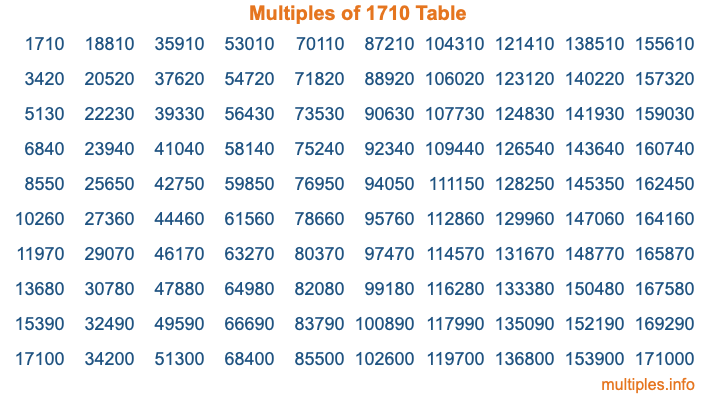
The Multiples of 1710 Table is also referred to as the 1710 Times Table or Times Table of 1710. You are welcome to print out our table for your studies.
Negative Multiples of 1710
Although not often discussed or needed in math, it is worth mentioning that you can make a list of negative multiples of 1710 by multiplying 1710 by -1, then by -2, then by -3, and so on, to get the following list of negative multiples of 1710:
-1710, -3420, -5130, -6840, -8550, etc.
Multiples of 1710 Summary
Below is a summary of important Multiples of 1710 facts that we have discussed on this page. To retain the knowledge on this page, we recommend that you read through the summary and explain to yourself or a study partner why they hold true.
There are an infinite number of multiples of 1710.
A multiple of 1710 divided by 1710 will equal a whole number.
1710 divided by a factor of 1710 equals a divisor of 1710.
The nth multiple of 1710 is n times 1710.
The largest factor of 1710 is equal to the first positive multiple of 1710.
1710 is a multiple of every factor of 1710.
1710 is a multiple of 1710.
A multiple of 1710 divided by a divisor of 1710 equals an integer.
1710 divided by a divisor of 1710 equals a factor of 1710.
Any integer times 1710 will equal a multiple of 1710.
Multiples of a Number
Here you can get the multiples of another number, all with the same attention to detail as we did for multiples of 1710 on this page.
Multiples of 1711
Did you find our page about multiples of one thousand seven hundred ten educational? Do you want more knowledge? Check out the multiples of the next number on our list!